(Unpublished bachelor’s thesis). Institute of Forestry, Pokhara, Tribhuvan University.
Aarati Khatri, Anju Upadhaya, Sunta Gautam
Abstract:
Timber is one of the primary products of the forest, and it is a key contributor to Nepal’s rural life.
Forest-based enterprises like furniture enterprises are a better option to mobilize natural resources,
generate huge employment opportunities and reduce poverty as they alone contribute roughly
NRs 5,000 million to the government annually. This study is about furniture enterprises in
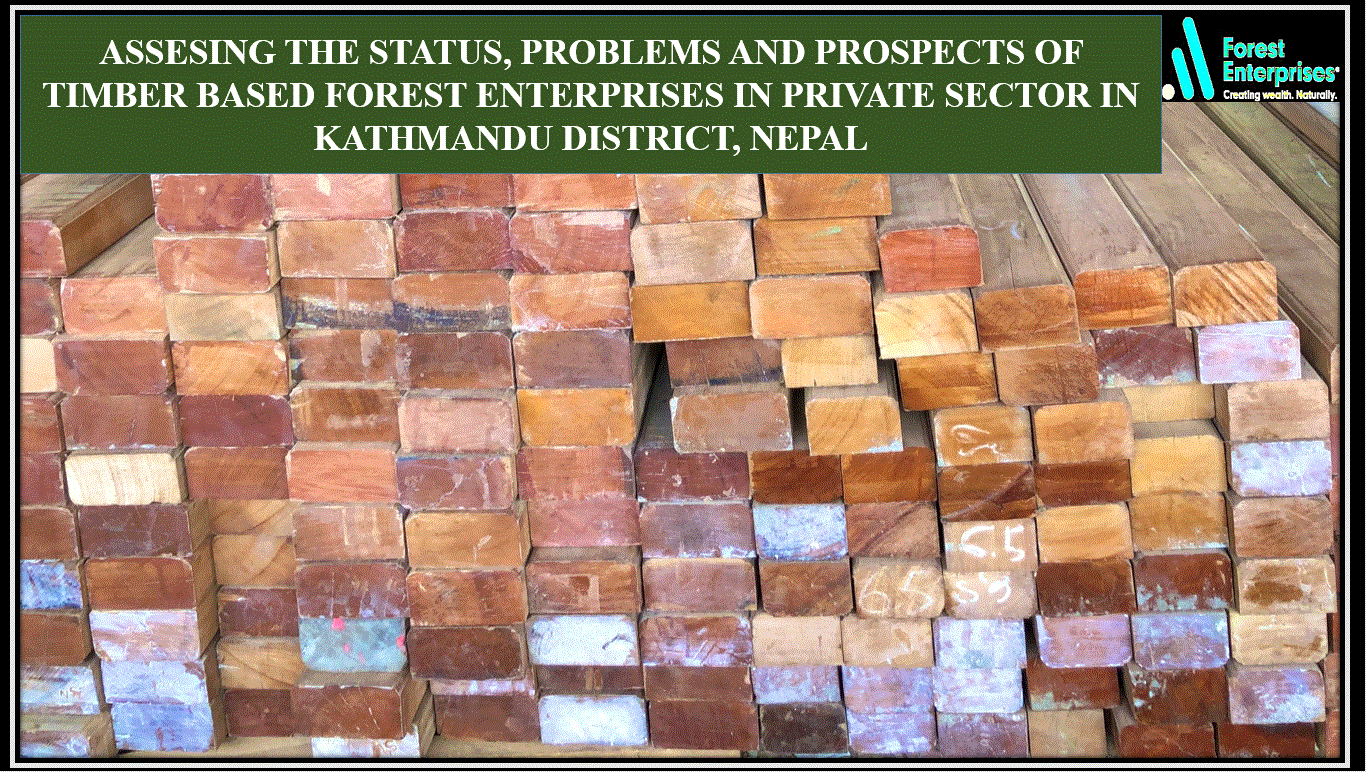
Kathmandu district to assess the status, problems, and prospects of timber-based forest enterprises
in the private sector. There was direct observation, key informant interviews (n = 10), an
enterprise survey (n = 60), and an online questionnaire survey. Relevant articles, journals,
published and unpublished reports were reviewed for secondary data collection. The collected
qualitative and quantitative data was analyzed using computer software packages like Ms-Excel
and SPSS. The major prospects assessed through this research are some technical, institutional,
and policy level strategies and provisions being enterprise-friendly, enterprises creating millions
of employment opportunities, contributing directly to economic development via tax, revenues,
and remittances, the opportunity to extend private forestry, utilization of overstocked and matured
trees, etc. Similarly, institutional barriers were found, like inefficient institutional mechanisms,
conflict regarding tenure and power rights, lengthy registration process of the enterprises, lack of
transparency and accountability in the institutional mechanism, and an irrational system of fixing
royalties and prices, etc. Also, technical barriers like shortage of new cross-cutting technology
and technicians, inadequate knowledge of enterprise development, and no insurance policy for
technicians’ ergonomy were found. Finally, policy barriers like unstable political scenarios,
nearly zero policies related to providing loans for enterprise development, non-involvement of the
private sector in policy level dialogues, tedious policies and bureaucratic hurdles, inconsistency in
government policies and weak coordination were assessed. So, to encompass all private
enterprises under business ethics, the private sector must first focus on organizational strength and
institutional reformation. Also, emphasizing the private forestry sector’s development, supporting
the importation of new or advanced technologies and shifting the enterprise model from
traditional to modern models are highly recommended. There is a dire need to address key policy
bottlenecks, and policy revisions should be pursued on a continuous basis to address the barriers
that hinder the operation of timber-based enterprises like furniture enterprises. Keywords:
furniture enterprises, timber-based enterprises, institutional barriers, policy barriers, technical
barriers, private sector.
For full thesis report:Aarati thesis Report